
More events, less value in AI-driven Event Storming Big Picture
AI can generate hundreds of events in seconds - but starting Event Storming Big Picture with them often leads to worse outcomes. Here’s why more input can reduce focus, limit discovery, and weaken the workshop’s value.
We are living in the AI era - there’s nothing to argue about. This is no longer the time to ask if it can help us or if it can make our tools and techniques more powerful. The real question is how to use it effectively and how to minimize the risks that can impact overall success.
Like it or not, mistakes are part of the journey. Not because we explore AI, but because we learn - and learning requires exploration, experimentation, and a shift in habits and mindset. All of this makes the process both exciting and, inevitably, error-prone.
Some time ago, I asked on LinkedIn whether Event Storming Big Picture still makes sense in an AI-driven world. Will AI make this workshop obsolete? Will it amplify its value? Or perhaps it has no real impact at all?
Now is the time to share my perspective.
Event Storming Big Picture - what is it?
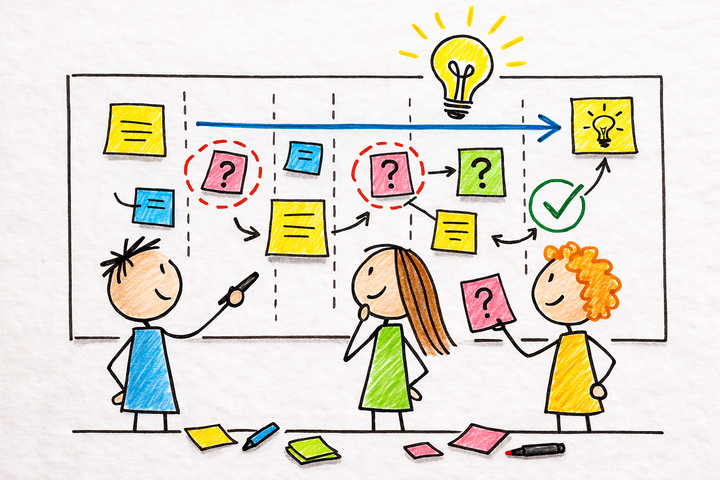
Before going further, let me briefly explain what Event Storming Big Picture is and why we use it. It’s a workshop designed to build a shared understanding of a domain, uncover knowledge that exists only in people’s heads, and expose unknowns and problems. The outcomes are extremely valuable. If you want to explore this further, I encourage you to check my previous series:
When AI generates initial events as input for discussion
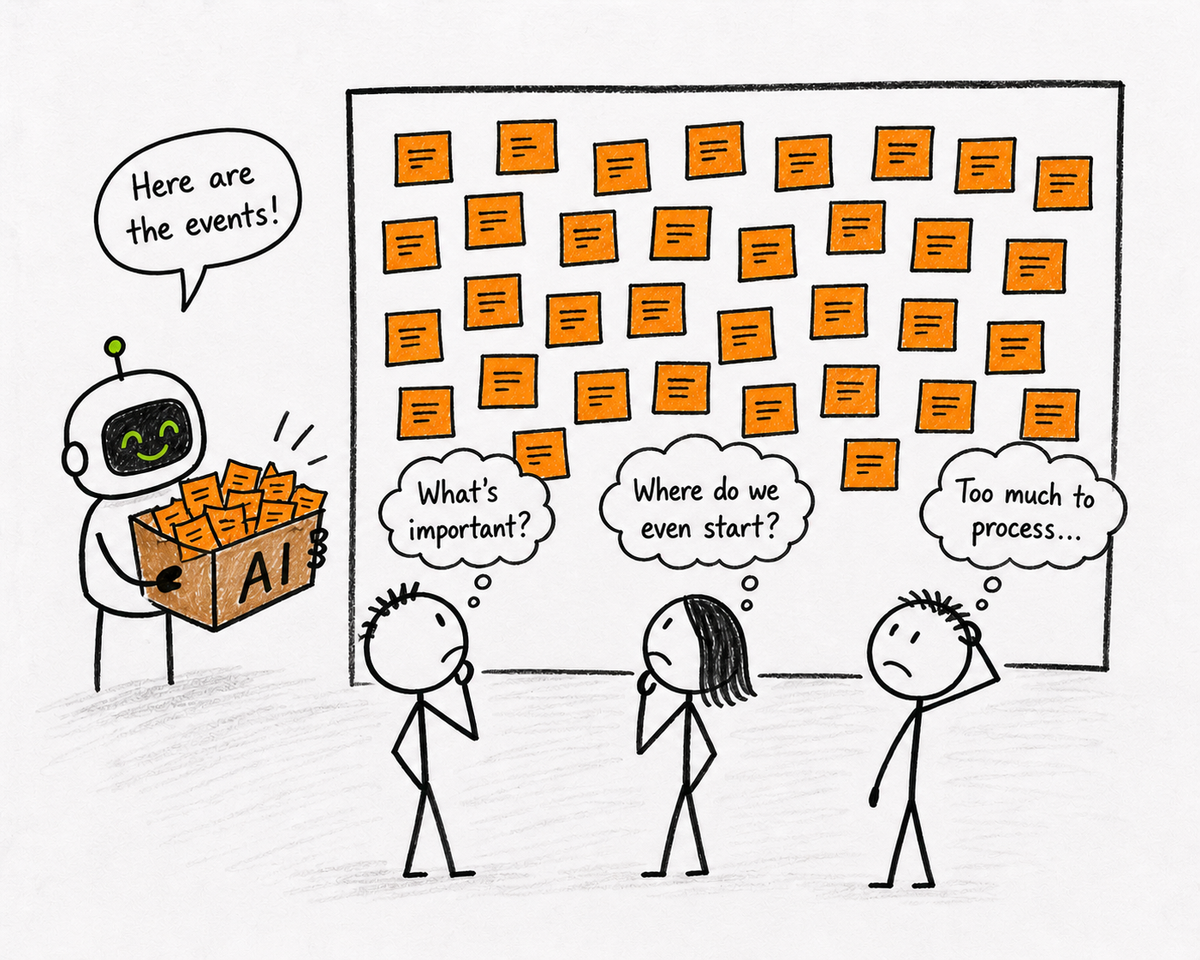
What if, instead of chaotic exploration and collaborative brainstorming, we asked AI to generate events for us? It sounds like a powerful accelerator: more input in less time. Instead of identifying events and then validating duplicates, we could start with LLM-generated output and use it as a foundation. In theory, this looks like a clear productivity boost.
But this is where things start to break down.
Additional noise that may not be relevant
In Big Picture workshops, we never have enough time to cover everything - and that’s actually a strength. During exploration, participants naturally place events on the board in the order they come to mind. These are typically things they consider important or things they are currently working on. This happens without facilitation pressure - our brains prioritize what matters.
Because of that, most events on the board are worth discussing: they are either critical to the domain or relevant due to ongoing change. This natural filtering disappears when the starting point is AI-generated input. Instead of a focused flow, you are faced with a broad, unprioritized set that requires additional effort just to decide where to begin.
Missing important events vs too many events
These are two different problems, and AI can introduce both at the same time.
First, missing important events. When participants create events themselves, they externalize what matters most to them - often including insights that are not documented anywhere. AI operates on existing knowledge, so it may omit events that are critical in your specific context. Once the group starts from generated input, their thinking can become anchored to it, making those missing pieces less likely to surface.
Second, too many events. AI can produce a wide and detailed set of events, including ones that are not relevant for a Big Picture session. This does not just add volume - it changes the dynamics of the workshop. Instead of discovering and prioritizing, the group shifts into reviewing and filtering.
One narrows perspective by omission. The other overwhelms it with excess. Both reduce the quality of outcomes.
Wasting time on unnecessary details
Without the natural prioritization driven by participants, many generated events may be too detailed for this stage. As a result, valuable workshop time is spent reviewing items that do not contribute to understanding the domain at a high level. Big Picture is not about completeness - it is about identifying what matters most.
Never-ending workshops
If less relevant or overly detailed events are not filtered early, the workshop can easily expand beyond its intended scope. Coordinating such sessions is already challenging, especially when participants come from multiple teams or organizations. A large initial dataset increases the temptation to “go through everything,” which often leads to too many sessions and diminishing engagement.
Big Picture workshops are intensive by design. Extending them unnecessarily reduces their effectiveness.
The (false) feeling of productivity
Starting with generated input may create the impression of efficiency - you begin faster and have plenty of material to work with. However, the depth of discussion tends to decrease. Fewer new insights emerge, and participants engage less in shaping the outcome.
Instead of a collaborative discovery process, it can feel like processing pre-existing content. The session appears productive, but the value is noticeably lower.
Summary
Event Storming Big Picture is about exchanging knowledge, building shared understanding, and discovering pivotal events in a domain. Starting with AI-generated input shifts the focus from discovery to processing, and that comes with trade-offs.
- participants do not externalize what matters to them
- discussions around duplicates and meaning are reduced
- vocabulary alignment becomes implicit rather than negotiated
- critical insights can be hidden or never appear
- the volume of input influences thinking and limits exploration
- participants may become passive instead of engaged
Faster input does not automatically translate into better outcomes. When used at the very beginning, AI pushes the process toward quantity at the cost of quality.
Does this mean AI has no place in Big Picture Event Storming? Of course not. But using it upfront to generate “all the events” often leads to weaker results. Where it actually supports the process is something I explore in the next articles.
What are your experiences? Have you tried using AI-generated events as input for a Big Picture workshop? What outcomes did you observe?
Comments ()