
Domain Types: How much should you trust AI?
Well-defined boundaries help AI understand your system. Domain Types answer a different question: how much should you trust AI? Learn where AI can safely accelerate development and where engineering judgment remains essential.
This article stands on its own, but if you'd like to explore the topic further, it's part of the Strategic Domain-Driven Design: Domain Types series:
1. Identifying core, supporting, and generic domains
2. Build, buy, or outsource?
3. What if you build nothing?
4. The architecture your subdomain deserves
5. Ownership is not random
6. How much should you trust AI?
7. Domain Types: Three Myths About Domain Types
I already wrote that well-defined boundaries support AI agents because they:
- establish well-isolated and cohesive contexts,
- keep the context consistent within boundaries,
- remove conceptual ambiguity.
All of that reduces the risk of hallucinations and makes AI responses faster and more cost-effective.
However, well-defined boundaries answer only one question: Can AI understand this part of the system?
Domain Types answer a different one: How much should I trust AI if it gets the answer wrong?
Not every mistake has the same impact. A bug in an integration layer is usually easy to detect and fix. A mistake in the core business logic may directly affect your competitive advantage.
That is why Domain Types are not only a strategic DDD concept. They also provide a practical framework for deciding how much responsibility you should delegate to AI.
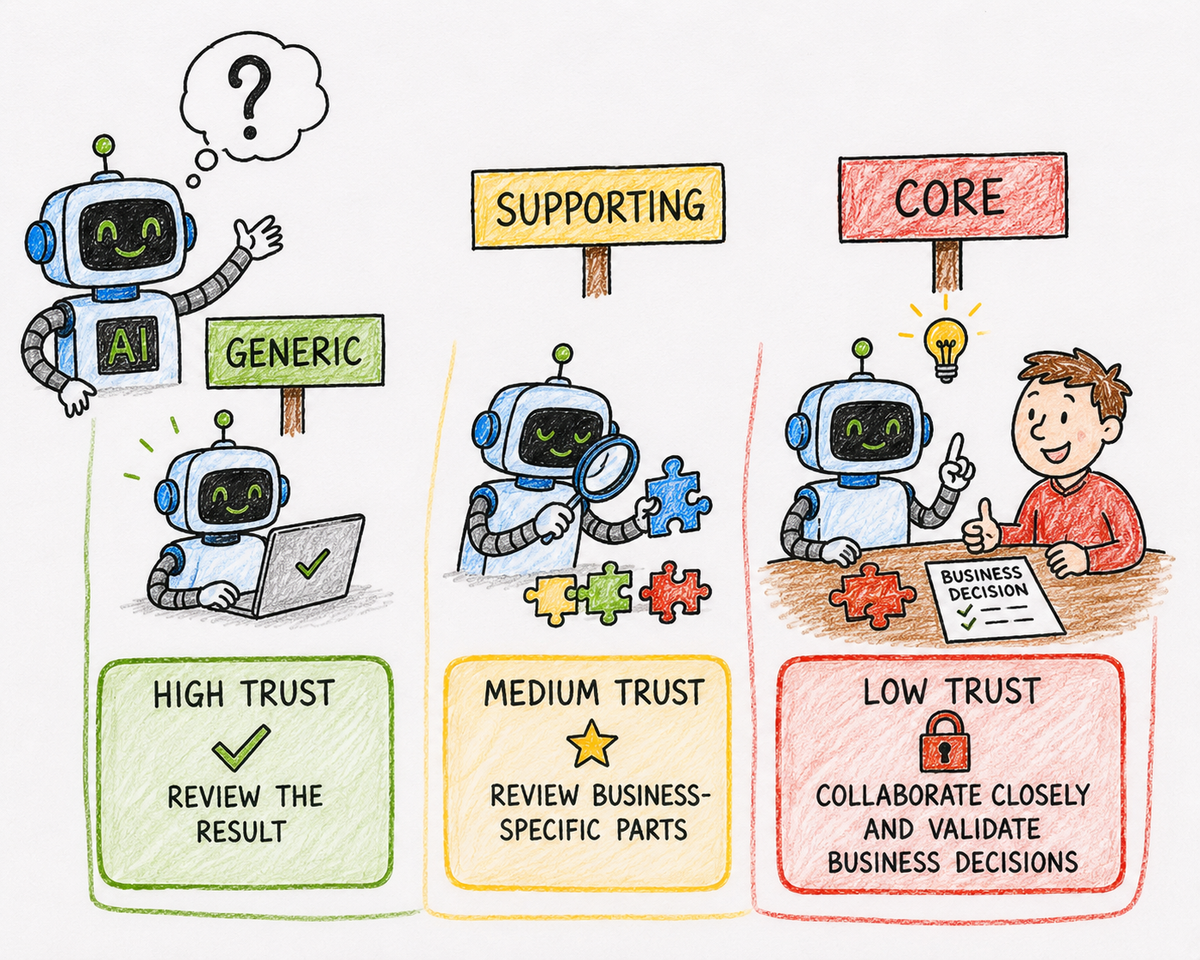
Generic subdomains and AI agents
These are the domains where AI agents will feel perfectly comfortable. From your perspective, you do not plan to dive deeply into these areas, which means the amount of code will be relatively small compared to other domain types, while domain-specific logic will likely be close to zero.
Here we have two possibilities:
- You plan to use external services, libraries, or frameworks. Let your AI agent generate the code. There is already a huge amount of information and examples available on the internet, and you are almost certainly not the first person integrating with them. In this scenario, an LLM can generate most, if not all, of the required implementation.
- You plan to use an internal reusable solution. This is not as straightforward as the previous case, but it is still mostly about integration and translation between components. AI handles these tasks very well.
From a risk perspective, regardless of the chosen approach, relying on AI-generated code is relatively safe because:
- most of the implementation focuses on technical integration rather than business rules, which is significantly easier for AI to generate,
- AI can leverage countless existing examples instead of inventing its own solution,
- even if mistakes or bugs appear, fixing them in this type of domain is usually straightforward.
Supporting subdomains and AI agents
The confidence level remains high for supporting subdomains.
First, if you follow the architecture recommendations I shared earlier, your business logic is well separated from the surrounding layers. LLMs perform very well when generating everything around the domain, such as queries, REST APIs, messaging, and similar infrastructure concerns, because these are common patterns with abundant examples.
Second, supporting subdomains are not where your competitive advantage is created. Many problems in this area have already been solved, even if not always as ready-made libraries or services. Even when they have not, the business rules are usually less complex than those found in the core domain, making them well within the capabilities of AI agents, especially with your guidance.
Core subdomains and AI agents
Everything outside the business logic follows the same principles as supporting subdomains. The business logic itself, however, is where the situation changes.
Your core domain is where your competitive advantage is built. By definition, this means there are fewer examples available for an LLM to learn from, making it much harder to generate a correct solution from a simple prompt.
This does not mean AI becomes ineffective. It means your role changes. Instead of asking AI to produce the entire implementation, you collaborate with it through multiple iterations, refining prompts, reviewing generated code, and validating every important business decision.
This is also the area where careful review becomes essential. Hallucinations, incorrect assumptions, or subtle misunderstandings of the business rules can directly affect the value your software delivers.
Summary
Domain Types are more than a tool for strategic design. They also help you decide how to collaborate with AI.
A simple decision framework looks like this:
| Domain Type | Trust AI? | Human involvement |
|---|---|---|
| Generic | High | Review the result |
| Supporting | Medium to High | Review business-specific parts |
| Core | Medium | Collaborate closely and validate business decisions |
The more generic the domain, the more confidently you can delegate implementation to AI. Existing knowledge, countless examples, and limited business complexity make these areas an excellent fit for AI-generated code.
Supporting subdomains still benefit greatly from AI assistance, although business-specific aspects deserve more attention.
The core domain is different. This is where your competitive advantage lives, and where human expertise remains indispensable. AI is still a valuable partner, but it should be treated as a collaborator rather than an autonomous developer.
Understanding Domain Types helps you decide not only where AI can accelerate development, but also where engineering judgment must remain in the driver's seat.
Continue the Strategic Domain-Driven Design: Domain Types series:
[Previous][Next]
Comments ()